
Kitch
Originally written for CultKW, posted September 2, 2020
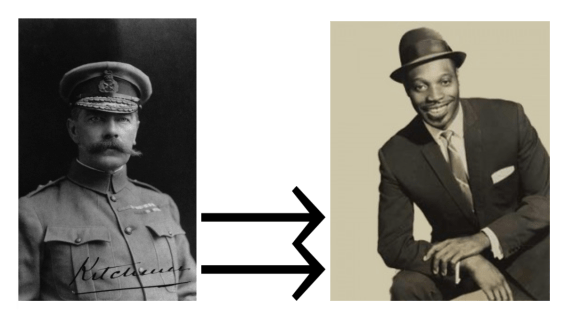
I’d like to make a motion: That the City of Kitchener be officially re-dedicated to the honour and memory of the other Lord Kitchener: Aldwyn Roberts, HBD DA, the great 20th-century Calypsonian.
April 18, 2022 would be a good target date: The centennial of his birth.
So what connection does this city have with the grand master of calypso?
Well, we can start with the simple fact we share the Imperial Field Marshal as a namesake. The connection came to this city through the debacle of 1916. For the calypsonian, we’re told that he took “Kitchener” as his stage name when he was a teenager, and his fans added the “Lord” later. The artist and the City shared this connection for roughly 60 years.
There is no need to disparage the City’s original namesake by any of this. The rationale can simply be, Lord Kitchener of Khartoum’`s memory has been honoured for 106 years, now let’s pay some attention to `the other Lord Kitchener for a while. There can even be a stipulation that the matter be re-examined in the year 2128, so future citizens can consider allowing the two heroes to take turns every 106 years or so.
Designating a day to think about Lord Kitchener and his 100 + year association with the city would be an honourable parting gesture: June 6, perhaps, the day that he drowned, which was just over three weeks before the day of the referendum that selected his name for this City.
A new spirit of Lord Kitchener the calypsonian would prevail the rest of the year, adopted in part because it is much more compatible with the ethos of the original Berlin, Canada than anything associated with Kitchener.
The main connection is the historical one that we share with everyone in the land of the Canadas. The theme that makes the story of Canada as a modern nation state exceptional is the fact that we never made a complete break with what came before.
The True North we sing about in the anthem emerged out of that vast global domain that was once symbolically embodied in the personage of Victoria Regina. And we are still associated with what remains of it, both as a present actuality and as memory. The empire is part of our story, and our stories are part of the empire and its legacy.
So in a very real way, the Canadas represent the fruition of England, France and even the Netherlands in North America, including all the treaties and other dealings with the Indigenous peoples of Turtle Island, and all the transgressions and other dealings with the peoples of Africa.
Naming a city after a legendary artist from Trinidad and Tobago would acknowledge all that. But this would be just a starting point for a full consideration of what this symbolic act would mean. The rest will be what we decide to make of it.
We’d be starting with a gesture that will likely appear as a joke at first. That’s OK. That’s not unlike the calypsonian way: serving up what are often “serious, even subversive, messages”1 with rhythms, sounds and words that are joyfully amusing.
And we can use some of that in the present hour. There’s not so much as a scintilla of fun in our current namesake, other than the fact that his stiff grandiosity almost begs for derision. It is difficult to imagine “the Avenger of Gordon, Lord Kitchener of Khartoum” could ever have earned an affectionate nickname like “Kitch”.
So we can keep the distinction clear by calling our new namesake “Kitch. Once the switch is made, the can also be applied to the City in ordinary usage: It can be become a Kitch, like a William becomes a Bill, and a Dorothy a Dolly or a Dot.
A lighter touch would suit the city. Part of the inheritance of the people who started coming from Germany in the 1820s is a more healthy attitude towards fun. This stems from the fact that they were Catholics and Lutherans, in contrast to the straight-laced white anglo saxon protestant provincial mainstream, which included most of the ruling elite.

One of the chapters in the souvenir booklet for Kitchener’s centennial in 1954 is “Always a Showtown.” The cover, on which the arts are given equal weight to industry, and the title: “City of Talent”, indicate this as well.
When it was first introduced, Kitchener’s Oktoberfest was a significant step towards showing Ontarians that they could have a good time eating, drinking, dancing, singing and exclaiming. It is our link to carnival traditions all over the world.
Canada as a whole has strengths in this area: We’ve become known for our humour. This is a gift that didn’t evolve out of Toronto the Good, or Sunday Blue Law Ontario.
Modern calypso emerged in conjunction with the capacity for recording and broadcasting music, and the evolution of the steelpan drum. It is rooted in African culture, and flavoured by the French presence during the 18th century and the proximity of Spanish colonial societies.
At the point when Kitch and the kind of music he created began becoming a global phenomenon, there were entire orchestras with instruments fashioned out of the 55-gallon oil drums made available in massive quantities through the U.S. military presence in the area.
Out of recycled material related to war, domination and environmental degradation, the people of Trinidad and Tobago created a magnificent musical instrument and a joyous musical genre.
This is an example one can pin some hope on: a sword into ploughshares, lion lying down with the lamb kind of development. And therefore much more in line with the pacifist origins of Waterloo County than the man in the recruiting posters.
As the horrors of the 20th century slip farther into the past, it becomes increasingly clear that the value of the gifts that Kitch and his people have given to the world far outweigh those of any military commander.
There is no need, however, to load the name switch with too much meaning. The possibilities are better left as a field of exploration and discovery.
The challenge will be maximizing the fun element, yet retaining the appropriate gravitas given that the Atlantic slave trade, the plantation system and modern colonialism are part of the background.
Although the land of the Canadas does have historical ties with the West Indies, it is important to remember that calypso, soca and steelpan music are a gift to the world from a Caribbean culture and society, and not ours to exploit.

It is worth noting that there are approximately 10,000 citizens of Caribbean origin in the Kitchener census area today, and that this is more than there were people of German background or the British Isles back in 1916 (the total population at the time was about 15,000).
The Caribbean includes many nations, each with a diversity of its own.
The ideal would be to make the switch part of the spirit of Berlinnova, and an avenue to meaningful connections, not just with Canadians with Caribbean roots, but with all the peoples, nations and cultures of the most southern regions of the continent we share.
Aldwyn Roberts is also the artist who sang “London is the Place for Me” for the newsreel cameras when he arrived on the famous HMT Empire Windrush to take England by a storm in 1948.
By making the switch, the City wouldn’t be overturning the imperial connections symbolized by Lord Kitchener the warrior. By embracing Lord Kitchener the artist, it would be embarking on a journey that promises to make those associations freshly meaningful.

Note: The Empire Windrush was originally a German ship called the MV Monte Rosa, built in the 1920s for trade with and emigration to South America
post script
Oktoberfest in May
Originally written and posted May 2021

The May Day signal went out in March: Kitchener-Waterloo Oktoberfest is facing a serious crisis.
There is talk of major changes in the works, aimed, as Oktoberfest Executive Director Alfred Lowrick has said, towards making it “a more family-friendly festival that celebrates the region’s Germanic roots while better reflecting the diversity that’s come to represent the area.”
That sounds reasonable. The best approach, when dealing with a time-honoured entity like this, is one that is progressive, but also conservative:
Protect and preserve, but also adapt. Renovate as needed; build anew where it makes sense to do so, but always build on what exists.
Taking steps to better reflect this region’s diversity is sound advice. The fact is, our diversity can be traced to those German roots: We are the only major Canadian settler city area whose founding tradition is neither anglophone nor francophone.
Thanks to those German language roots, we have reasonable claim to be the birthplace and capital of allophone Canada. And a 21st century Grand River Country Oktoberfest can play a leading role in making such a claim.
To that end, here are nine points of advice:
1 Keep the German language and culture foremost, but broaden it to encompass the German-speaking world in the 21st century, both in the homelands — Germany, Austria, Switzerland — and throughout the diaspora.
It could even be all Germanic languages, including what anglophones call “Dutch”, which is my native tongue. And if we go that far, we might as well go all the way and make it allophone Canada in all its diversity.
2 Keep the role of the German clubs central — Concordia, Schwaben, Transylvania, Alpine, Hubertus Haus. A smart move would be to invite involvement from other cultural associations, especially those that own and operate their own places and spaces. There are dozens of them. All of them face challenges. They’re better off working together.
3 Keep the beer, the sausages and the sauerkraut. It’s high time, though, to move beyond the domestic beer duopoly and towards artisanal and legacy brewing, especially independent production here in Grand River country, but also the beers of the whole wide world.
That goes for artistry and tradition in fermenting and preserving as well. If local Koreans came forward to share the kimchi tradition, it wouldn’t diminish celebrating sauerkraut in any way. The enjoyment of bratwurst and frankfurter würstchen is fully compatible with an appreciation of chorizo, boerwors, sujuk, makanek, longganisa, sai oua, or alheira.
4 In a similar vein, strengthen the polka component, but complement it with offerings from comparable popular dance traditions from around the globe: rumba, flamenco, dabke, square, line, swing, jig, shuffle, … .
Say it’s the Levant group, representing people from the Lebanon, Syria, Palestine, Jordan and Kurdistan area, that steps forward to bring Dabke dance into Oktoberfest. Some polka people might take it up, but they can also stick to pure polka if that’s what they prefer.
5 Keep the harvest theme, but deepen the meaning to include celebrating
- the Waterloo County food tradition;
- holding the line to protect the farmlands of Greater Waterloo, and
- giving thanks for the beauty and bounty of our earthly home.
6 Keep the downtown Kitchener base, but aim towards a festival that manifests an ascendant spirit of “Berlinnova,” as the visionary Kitchener artist Edward Schleimer advocates. There has been a renaissance bursting to emerge for decades now. A 21st century Oktoberfest can help this city to truly flourish in ways it hasn’t been able to since the tragedies of the First Great War.
7 Hold fast to October – all of it, not just a nine-day slice. Extol the glory of autumn in Southern Ontario, and throughout Great Lakes North America as a whole.
8 Put the maypole up on May Day. October was once the eighth month. The time to begin preparation for a great harvest festival is when the original new year turns — i.e., months 1, 2 and 3. That means right about now, as our spring planting holidays unfold: the original new year at the vernal equinox, Easter, Earth Day, Arbour Week, May Day, Mothers Day, and Victoria Day.
9 Make land acknowledgment an integral part of every aspect of planning a revitalized Oktoberfest.
There are many ways of saying that Kitchener’s Oktoberfest takes place on the traditional home of the Neutral (Attawandoron, or Chonnonton), Anishinaabe, and Haudenosaunee peoples.
It is a matter of fact that Kitchener, Cambridge and Waterloo are all built on the Haldimand Tract, the lands granted to the Six Nations from Upstate New York, refugees from the War that led to the separation of the United States.
Our community could lead the nation in developing a meaningful and distinct allophone Canadian dedication to honouring the promises and agreements with Indigenous peoples on which British and French North America were founded.
 Martin de Groot
%20windrush&ved=2ahUKEwix9-L-0anqAhUHOa0KHZctANMQMygEegUIARCrAQ)