
Kitchener
Originally written for CultKW, posted July 20, 2020
“He is not a great man, he is a great poster.” – Margot Asquith

Let’s face it, Kitchener is a weak name. “Tacky” is the word that keeps coming to mind, but that’s not quite it. There’s just something awkward about it. This could be why you hear people say “Kitchener-Waterloo” so often, to mask the embarrassment.

Ah, but why get all bothered up about it once again? There’s a point when it really doesn’t matter any more. They’re just three syllables. The KI’-chuh-nr sound has been used to designate this Canadian city for 104 years now.
Time has taken us beyond living memory. There is no one left who can remember hearing the original two-syllable name spoken during the brief time it applied (the City of Berlin only lasted four years).
A joke I once heard from a stand-up comedian on a late night talk show comes to mind; I don’t remember his name or what show. At one point in his routine he says something like “I’m quitting the comedy game and going back to graduate school. I already know the title of my dissertation: ‘Lincoln: The Man and the Car’”.
When I mention that line, as I have many times over the years, it is remarkable how often people say that they never made the connection.
A name change can be divisive. Since Kitchener, Ontario has been around for more than a century now, changing it would be an erasure to correct an erasure.
It can also be expensive: all those signs that have to be altered; all those business cards that have to be replaced; all those websites, road maps, brochures, lettering, ancillary branding … everything “K-W” would have to go too.… . But it could be worth it. Because the name is not a good fit for a great Canadian city, especially not this particular great Canadian City.
What I’m interested in is what makes Berlin/Kitchener exceptional, starting with how it all began.
Have you ever heard of Zelinsky’s “Theory of First Effective Settlement”? Wilbur Zelinsky was a U.S. cultural geographer who postulated that, in a settler colonial situation, when a territory is newly settled, the cultural characteristics of the first group that is able to establish “a viable, self perpetuating society are of crucial significance for the later social and cultural geography of the area, no matter how tiny the initial band … .”
I like to imagine this is true, and enjoy looking for traces of the patterning process in operation.
We associate the County with the plain folk who made their way up here from Pennsylvania, while Berlin the town came into its own when German-speaking immigrants began arriving in the 1820s (nudge: another bicentennial coming up).
This is the only major Canadian settler city whose founding tradition is neither francophone nor anglophone. So we have a reasonable claim to be the birthplace and capital of allophone Canada. And I’ve argued that we should make that claim, with the region’s “deutschophone” population taking the lead.
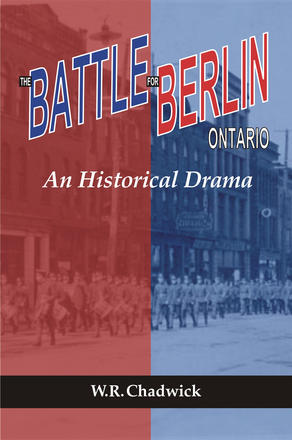
The years leading up to the name change in 1916 were a hateful time. The British Empire was at war, and Canadians were putting their lives on the line to save it. It was our patriotic duty to do so, because the Empire was part of what we were, and we were part of the Empire. It was cowardly, perhaps, but understandable that local manufacturers would want to disassociate with the once proud “Busy Berlin” brand.
A year later the British royal family yielded to pressure to take a similar path, and changed their name from Saxe-Coburg and Gotha to Windsor.
But at least that name has some association with the family that adopted it: Windsor Castle was built by William the Conqueror, and has been used by the reigning monarch since his son Henry I ascended to the throne, which makes it the longest-occupied royal palace in the West.
Field Marshal Horatio Herbert Kitchener, 1st Earl Kitchener KG, KP, GCB, OM, GCSI, GCMG, GCIE, PC had no connection with Berlin, Ontario, Canada whatsoever.
What happened here in 1916 is one of the reasons why, if I was ever in a position of influence in Ottawa — a Senator, say — I would put forward a private member bill to ban decision-making through a simple majority referendum on any important matter in the Canadas forever and ever, at least any important matter pertaining to the whole.
The name change of 1916 is understandable, and although it was barely legal and far from fair, it was probably wise for citizens of Canada’s Berlin to accept their fate and get on with living, working, learning and associating.
But what happened here during the Great War may have damaged the City in ways that have never been repaired. What sticks in my mind is something that Stuart Scadron-Wattles of Theatre & Company said at one of the public meetings about downtown revitalization long ago — I think it was for Mayor Richard Christie’s Task Force on the Downtown in 1995.
“You people hate yourselves”, he said. He told us that he’d lived in many places before coming here from the U.S., and had never seen a community with such a low level of self-esteem, confidence and civic pride.
He went on to hypothesize that this may have something to do with what happened here in 1916.
A city can carry on, but it doesn’t simply buckle down and “get over” something like that. For the industrialists of busy Berlin, it was a brand makeover. But the final outcome of the Battle for Berlin, Ontario also lays a burden of shame and guilt on a segment of the citizenry for associations they acquired at birth.
It is, however, possible to imagine a radical break from a pattern of blame, shame and low self-esteem.
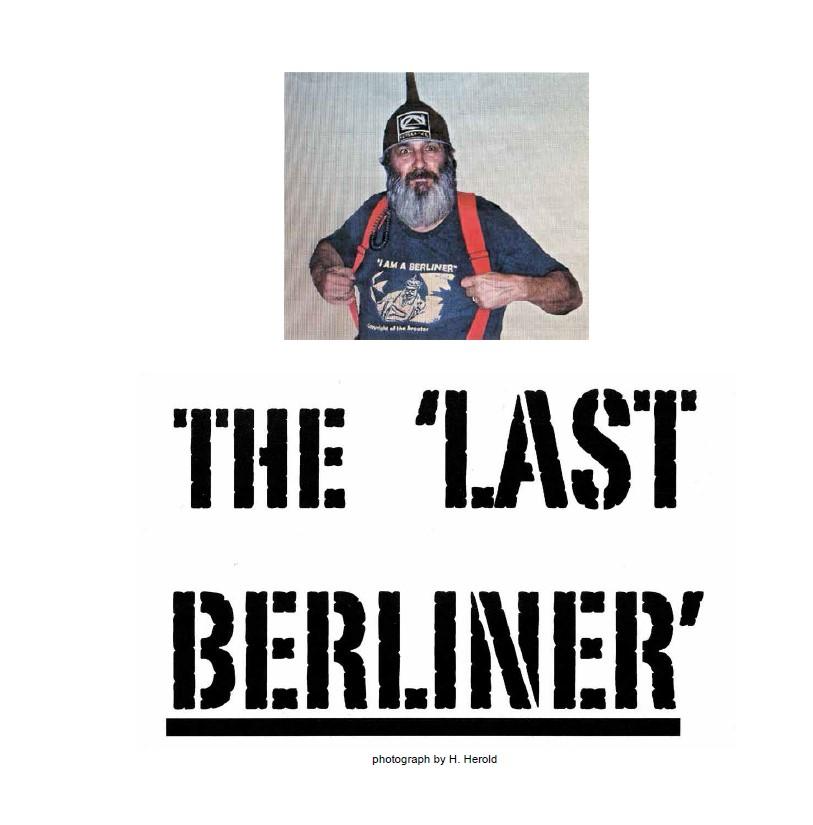
Kitchener artist Edward Schleimer, the grand champion of name change supporters, feels that burden deeply. He calls himself the “Last Berliner”.
Aware of the limitations and complications of reverting to the original, Schleimer offers an alternative: “Berlinnova”.
It is a proposal, not just for a name that reconnects the city with its origins, but also for a new spirit, a new morale: a great flourishing of faith, of industry, and of culture in every sense, including arts&culture, folk cultures, Indigenous cultures, even horticulture and agriculture.
Schleimer’s writing includes complex layers of meaning, symbolism, riddles and word play, which can seem like deliberate obfuscation, but what he’s writing about are actually glimpses of a vision that cannot be readily encapsulated in an abstract or an executive summary.
Would the Last Berliner be satisfied with “Berlinnova” as the name of a movement, an ethos, a renaissance, without an official name change? I don’t know.
There could be other symbolic gestures towards reconciliation short of a full name change. For instance, I’d be all in favour of doing a switch, and re-renaming the city’s main civic space “Berlin Square”, as originally intended, and reciprocally honouring our long serving recent mayor with a “Carl Zehr Tower” at City Hall.
I’d be in favour of naming the area within what the new city’s limits were in 1912 “Berlin Town”, as an alternative for “downtown” or the “core”.
“Berlinnova” could be a place as well as an ethos. It could designate everything up to the Conestoga Parkway, Westmount Road and the Waterloo line, or all parts of the city that were contiguously built, from the Royal Crossroads outwards, up to 1950 or so.
There could be a Berlin, Canada Day to commemorate the 83 years a village, town and city by that name flourished in Upper Canada/Ontario. August 30, perhaps, which was the last day before the name change came into effect in 2016. Or, since the aim is to spark a renaissance, August 28, Goethe’s birthday.
Since it was Europeans fighting one another that caused all this trouble, it would be fitting if Berlin, Canada Day would be a celebration of peace, especially the peace that has prevailed in the Old World since May, 1945.
Europeans today like to emphasize that this is now the longest period without war since Pax Romana, the relative peace that began with the reign of the man we still honour with a whole month every year, Imperator Caesar Divi filius Augustus. It lasted about 200 years.
But Berlin/Kitchener is not Europe. The 205 years of peace between the original Canada and the prodigal republic to the south is also something worth celebrating. And we can go beyond that: the spirit of Berlinnova can aspire to future peace, not historic peace alone, and work towards peace on earth, not just here and there.
For Kitchener at large, I have another idea.

 Martin de Groot