Last Minute (Ontario) Election Thoughts

Tuesday May 31, 2022
Original Kitchener, Waterloo, Ontario, Canada

Two days from now the people of Ontario will decide who to entrust with the government of our province for the next four years.

I am not able to give impartial commentary on provincial matters. A deep revulsion over what happened here in the wake of the “Common Sense Revolution” of 1995 has been a factor in almost everything I’ve said and done since. I remain committed to doing anything I can to undo the damage that was done, to ensure that what happened isn’t forgotten, and to prevent anything like it from happening again. 

Beyond speaking out on related matters every now and then, I haven’t been able to do much. I’ve learned that to make a difference you need to either join together with others, or convince others to work with you.   

I know how I’ll vote this time around, and why. For anyone who is still undecided, here are a couple of resources for “strategic voting” in the provincial election: 

votethemallout.ca

votewell.ca

The VoteWell site, which comes out of Victoria, B.C., explains the purpose this way: “There are 3 national parties in Canada with leftist politics, and only one that is right-leaning. This often causes a ‘split vote’ among leftist voters, giving the right an over-representation of electoral seats.” 

The message here is that we need to vote carefully, and take into consideration the odds, riding by riding. Which is what I’ve always done. But I don’t like the idea of “strategic voting”, and will try to explain why.  

To begin with, I don’t consider myself left-leaning, at least not in relation to a right as represented by the forces that dominate the Progressive Conservative Party of Ontario, their federal and other provincial counterparts, and, of course, the wellspring: the hard core Republican consortium down in the U.S.A.. 

The reality is that there are three viable moderate-centrist parties with progressive tendencies in this election, and one hard-line radical-libertarian party with retrogressive, obstructive and destructive tendencies. The distinction is not a bifurcation within a continuous spectrum, but between two completely different ways of seeing the world and our place in it. 

If I’m wrong, and the old left-right spectrum remains relevant, I want no part of it. And that’s a lonely position to take up. My place in relation to the body politic would be analogous to that of an Old Order Mennonite or a Doukhobor. 

My sense is that this core driving force in the PCO, CPC and GOP is out of tune, not just with the majority of citizens of both Canada and the United States, but with the reality of our time. It is also a contradiction of almost any reasonable combination of principles, ideas or moral standards. This is an optimistic view, but I’m trying to hang on to it. Giving up would be saying you can fool most of the people, year after year after year, which is tantamount to giving up on democracy itself. 

The Progressive Conservative Party of Ontario as currently constituted remains a force to be reckoned with only because it has been able to fool large numbers of Evangelical and Catholic Christians into voting with them, while skillfully managing to exploit, exacerbate and foment fear, resentment, suspicion and hate whenever the opportunity arises. 

Progressive and, I would argue, conservative in name only, the party that Doug Ford leads remains viable because they have retained the support of both traditional, true blue conservatives, especially in small town and rural settings, and of those who still identify with a political tradition that is nearly extinct: the anti-republican, anti-revolutionary “Loyal She Remains” strain on which this province was founded. 

The form, practice and culture of political parties as they function today are part of the problem. But I do believe in purposeful association and organization, even in the municipal sphere, where Canadians have generally tried to avoid formal partisanship. 

A key consideration for me is the question of what constitutes a constituency. We don’t vote as a province or as a country, but riding by riding. And while the process through which electoral districts are defined in Canada is far superior to the way it’s done in the United States, where partisanship corrupts the process, the effort to sort the body politic into roughly equal sections leads to some strange configurations that can be a hindrance to the democratic process.

My riding, Kitchener, has a certain integrity, but it is awkward to have parts of the city sectioned off and portioned out, some to Waterloo and others to the two sprawling suburban-rural ridings nearby so that the principle of rep by equal pop is maintained.

To vote strategically is conspiring to have it your way. You’re wheeling and dealing in order to outmanoeuvre what you consider your competition. It suggests that elections are contests between opposing interests and wills. What you do in the privacy of the ballot box is either a quiet profession of your personal convictions or making a calculated move in some kind of game with winners and losers. 

I’m not interested in having my say, or in silently professing my political faith, or even in determining an outcome I prefer. An election is democracy at work: a collective process, through which we, as citizens, deliberate, and make decisions about how to best move forward into the near future, together, as a city, a township, a province or a nation. And the “we” in our system is everyone within a particular constituency, however shaped and defined. 

It’s the deliberation process that matters most. What’s missing is a procedure for reaching a final decision. So the best I can do is to try to guess what my fellow citizens are thinking, and try to align with enough of them to constitute at least a plurality, and ideally a majority, on election day. 

Right now, especially with the diminution of local and regional media, there are few channels for meaningful deliberation. Public forums, all-candidates meetings, questionnaires and so forth certainly can help, and have been steadily improving. But they have a narrow reach. 

Essentially, elections are decided through rival advertising campaigns devised and distributed from metropolitan centres, and sent to our homes as standardized packages. They leave little or nothing to discuss. There is no reliable way of getting a sense of which way your fellow constituents are leaning, other than the kind of poll numbers provided by services like votethemallout.ca and votewell.ca. 

Despite those limitations, I’ve been satisfied with the results in my constituency. Over the last decade or so, I’ve voted red, orange and green, but always for the winning candidate. The last time a plurality voted for a party that I couldn’t possibly support was in 2008. Even then, I rather liked the winning candidate as an individual human being, and was able to have meaningful and productive discussions with him.  

But a plurality shouldn’t be enough. Declaring a candidate with less than a third of the eligible votes the winner is leaving things hanging. Our election process doesn’t give us a chance to come together to form a majority and make the decision firm. 

In a healthy democracy, of course, the final step would be for the body politic as a whole to declare support for the decision that was made through the democratic process. Once you’re elected, your job is to represent everyone in your riding. But that’s not possible when one party is an outlier, and the choice is between two completely different ways of seeing the world and our place in it. 

A house divided this way cannot stand. A body politic at odds with itself is diseased, and cannot live a full life. 

A progressive tendency means moving forward, adjusting to the needs of the times, and making improvements along the way. It doesn’t require unity or solidarity. But there does need to be harmony and balance. Treating a renegade party with retrogressive, obstructive and destructive tendencies as an acceptable option would be like trying to walk with one leg stepping forward while the other insists on going sideways, backwards, jumping up or kneeling down.  

Proportional representation would make things even worse. This would, in effect, turn political parties — partisan configurations of varying sorts — into constituencies. Instead of coming together, it would make division permanent, and reduce all political activity to brokering deals. 

There must be better a way. Meanwhile, we have to make do with the system as it exists, and the resources currently available.

According to VoteWell, it is not necessary to vote strategically in Waterloo or Kitchener, where people seem to be satisfied with their current representatives in the legislature, and neither of them are with the renegade party. For the other three constituencies in Waterloo Country — Cambridge, Kitchener-Conestoga, Kitchener South-Hespeler — it looks like the strategic vote, the responsible vote, the informed vote is orange this time around, with those leaning green holding the balance of power.  

I would work under the green banner if it became a movement dedicated to facilitating responsible collective decision making, finding solutions, and getting the work done, rather than a party in the root sense: a division, a parting, a separation. Questions of how we, human beings, relate to the planet, to creation, to our earthly home are not a priority, but a commonality: They are fundamental to all other considerations, and therefore a concern that should be bringing us together, not setting us apart from one another.  
Victoria Day Reflections 2022

Original Kitchener, Waterloo, Ontario, Canada

Tuesday May 24, 2022

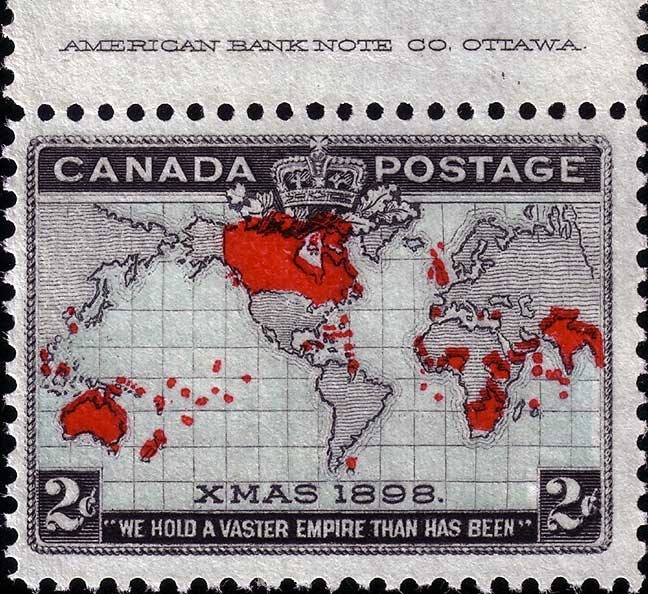
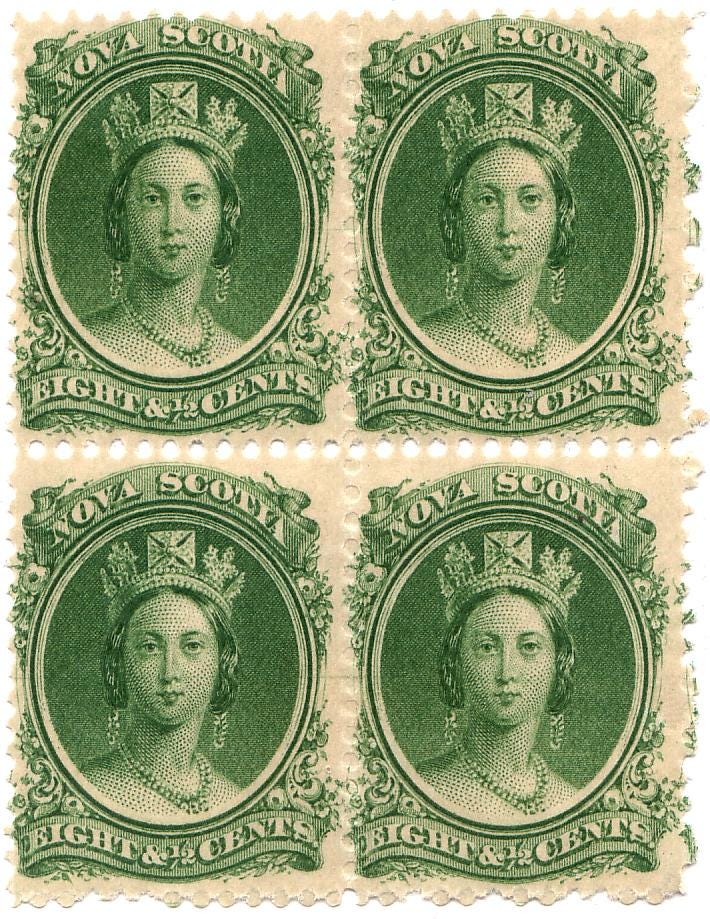
British North American postage stamp, 1860

I’ve just finished re-posting, with minor revisions, Victoria Day columns originally published in 2020 and 2021: On Further Reflection: Victoria Day 2020; and On Further Reflection: Victoria Day 2021.

With the former, there’s a note to say that, two years later, “I still love Victoria Day /  Fête de la Reine as celebrated in Canada, especially here in Upper Canada, for all its quaint peculiarities. I also have a deep and abiding fondness for Cavaliere Raffaele Zaccaquini’s landmark sculpture of Victoria and the Lion, which has been controversial of late, having become the object to the same kind of vandalism that led to the removal of the statue of John A MacDonald and other Prime Ministerial personages in Baden.”

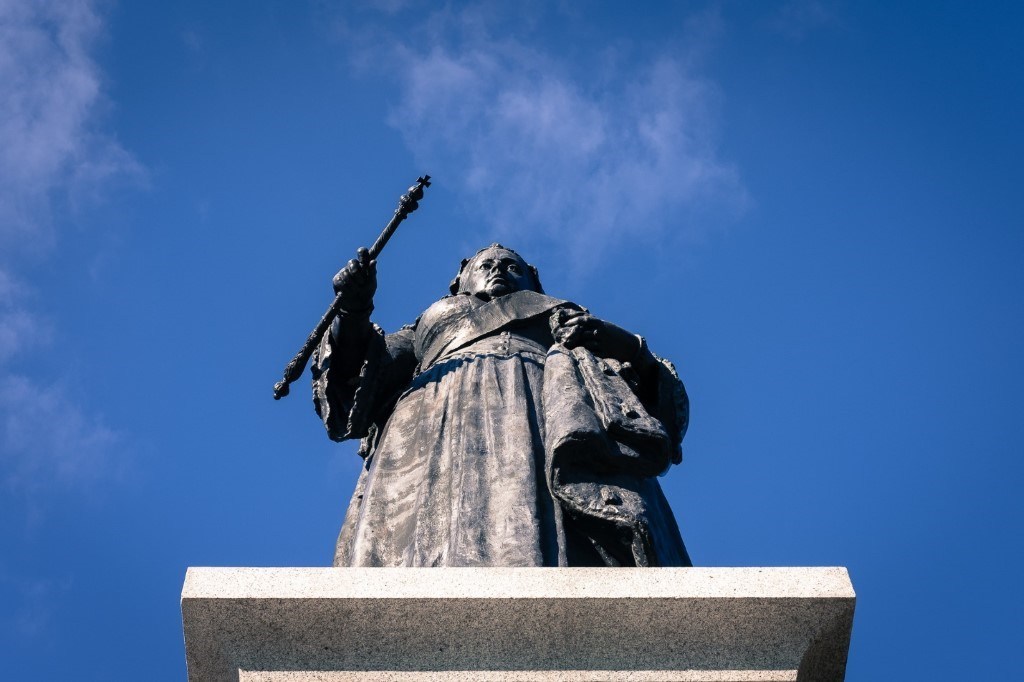
I have no fondness for the ill-fated Prime Ministers’ Path project, but do sympathize with both the organizers and the artists who were commissioned to do the work. But I love Victoria Park, which has been the heart of Berlin and later Kitchener, Ontario for 126 years, and all it’s essential elements: the lake, the iron bridge, the band shell, the pavilion, the boat house, the trees; the monumental souvenir of the city’s majestic old city hall; the plinth where the Kaiser’s bust once stood, and, maybe best of all, the grand Empress cast in bronze, with the imperial lion reclining at her feet.    

So for me, the defilement is disturbing, painful and discouraging. I am alarmed over the impending loss: This public art work, a gift to the people of our city from a once powerful association of patriotic women that is holding its 122nd annual general meeting in Winnipeg this week, is fragile. They may end up destroying it.

But I have no desire to take up a routine binary, pro vs. con stance on the various issues that come into play here. The prevailing winds are clearly against the Queen who was born 203 years ago, and who has now been dead and buried for much longer than she lived, breathed and ruled over that Empire on which the sun never set. 

These are centuries old battles, and my sympathies are drawn toward the losing side, to what is generally neglected and forgotten, mocked and scorned. What we need, though, is peace and love; truth and reconciliation, not a settling of old scores or a return to lost causes. I firmly believe that truth, justice and what I hold to be the Canadian way are best served by complicating the picture, starting with broadening what is taken into consideration and enriching the story with nuance, colour and detail.    

We can make of these vestigial symbols what we choose. To me, Victoria wielding her sceptre and looking down from her pedestal, signifies, first and foremost, that all that Canadians have accomplished as a self-governing nation state among nations has been done peaceably, without the violent overthrow of an existing order, without a total break from the past. This is the essence of what distinguishes us from the separatist republic to the south, and perhaps the only cogent justification for maintaining a separate existence and staying together as a confederation of cultures, nations and settlements.

I also choose to think of the statue as a symbol of associations that were not always peaceable, and far from equitable, but real nonetheless. It is a reminder that what is now Canada originated as part of an entity that was global, and encompassed many cultures, faiths, languages and skin tones from the outset, and that this has shaped what we have become and are becoming.  

There are parks — dedicated civic outdoor gathering places — named after Victoria in towns and cities from sea to sea. In the early decades of Canada under home rule, municipal parks were still something new, and it is remarkable how many growing settler communities chose to name their central park after their Queen. 

photo courtesy Harold Russell, a child of Victoria Park

​​Early Evening in Victoria Park on Victoria Day Monday, May 23, 2022

What strikes you about Victoria Park is the diversity of the people you find there, much more so than at any other Kitchener gathering place, including the Market. Victoria Park is always busy – people walking dogs, playing soccer, or hanging out on the steps of the clocktower monument, pushing a baby carriage or minding a child on a bike. This Victoria Day Monday (one day before the actual May-2-4), on a mild evening, a group of young men were passing around a now perfectly legal toke, and just chilling, while a diverse stream of people passed by the fountain commemorating the journeys and arrivals of immigrants and refugees in the city. 

However, the real party, I discovered, was deeper inside the park. On the other side of Jubilee Drive, past the underused pavilion, starting with the playground, hundreds – perhaps thousands – of people had come out to celebrate the Monday off, almost all of them people of colour. There were picnics on the grass, picnics at picnic tables, children running and climbing, old people strolling, teenagers hanging out, young people flirting, boys with bicycles hanging out, men in groups – people in all kinds of clothing,  girls in white Sunday dresses, men in flowing robes, women with elaborate headdresses, and kids in jeans and sneakers.

I had not seen anything like this since leaving my home country, in Eastern Europe, on a May 1 or an August 23, the good-weather national holidays, when people came outside to be together, just like here, in Victoria Park: not so much in nature as punctuated by nature – on the grass, the groups spaced out by trees and bushes. 

There was not much music – a car radio in the full parking lot, not too loud – and the occasional pop of a firecracker that nobody paid attention to. The main sound was of people talking to each other. For a moment I thought I was the only white person there – but there were others, like me, passing through this immense family party. I felt I had witnessed something special, all these people so comfortably at home in the park, in the heart of the city.

In historical photos and descriptions of Victoria’s Park the crowds look very different. Although the languages and the accents have always varied, this visible diversity is a relatively recent development. And yet, as the statue of Victoria and the Lion can remind us if we so choose, the scene on Monday as my friend describes it is a reflection of connections that have been there for centuries. 

I am ready to concede, though, that there are many ways to tell a story without departing completely from the whole truth, which is unfathomable in its complexity. If you choose to see Victoria and the Lion as a symbol of oppression, conquest and domination, that’s your prerogative. It puts you in line with what has been the prevailing view, on this continent and around the world, since the alarm was sounded that the red coats were coming, and those shots were fired at Lexington. 

If this were true, how simple our strivings and struggles would become. If a coterie of pampered royal brutes are ultimately responsible for all the hate, and all the suffering that have plagued humankind over the centuries, something as simple as a guillotine could deliver us from evil (or, in the case of graven images that idolize tyranny, a smelting furnace or bit of room in a scrap yard somewhere). 

But at most, this would only be the tiniest sliver of the whole truth. Finding others to blame may seem like a convenient solution, especially if the guilty party has been dead for more a century. This leaves us, the living, completely off the hook. But this will not move the human race an inch, not even a millimetre, towards deliverance, redemption or reconciliation.

Time for a Reset

Original Kitchener, Waterloo, Ontario, Canada
Tuesday May 24, 2022

Another Victoria Day weekend has come and gone here in the original Canada West. I’m writing this on the Empress Victoria’s actual birth anniversary — her 203rd — which is Tuesday May 24.

Two years ago I started writing a bi-weekly column of “musings” for CultKW, a project of THEMUSEUM in downtown Kitchener. They called it I am Groot, with the tagline “still musing after all these years”. After an introductory column, I began the series with reflections on Victoria Day 2020.

I’d also started writing occasional posts for a personal website, and carried on with hosting and editing a weekly “community radio magazine” that airs on 98.5 CKWR, Canada’s first community radio station. 

Last fall, in the wake of the 2021 federal election, I launched a Substack newsletter. The inaugural post was an open letter to the freshly elected or re-elected representatives to Canada’s Parliament from our neck of the woods. The intention was to begin sharing thoughts with a more political focus giving equal weight to the three spheres of our democracy: federal, provincial and municipal. I called it “The Evening Muse, a newsletter of reflections from here, now and then”. 

The radio magazine continues to run, although no longer as a project of the Commons Studio at The Working Centre. The wordsmithing, however, started petering out, for a variety of reasons. But my thoughts continue to race along. They need some kind of outlet. It’s time for a re-set, and there is no better time for new beginnings than spring planting time, after the last day of frost.

I don’t think there’s room for any new channels or directions. As it stands, there are three mainstream platforms I use regularly, including contributions to eight different pages and groups on Facebook alone, along with six websites of one kind or another. There is a need for consolidation, but not prioritization. I want to carry with various threads that were introduced along the way.

So the plan is to go back to the beginning, and repost, with a few revisions here and there, all the writing that I think remains relevant in some way, along with a few comments explaining why. 

Meanwhile, I’d like to return to a more regular output, starting with the original twice per month. I’ll start utilizing the Substack platform, because it seems the most versatile, but keep marinusdegroot.ca as a mirror site and a repository for “On Further Reflection” re-posts.  

The Victoria Day, 2020 post seems a good place to start. I’m posting it here, with minor revisions, and a note to say that << I still love Victoria Day /  Fête de la Reine as celebrated in Canada, especially here in Upper Canada, for all its “quaint peculiarities.” I also have a deep and abiding fondness for Cavaliere Raffaele Zaccaquini’s landmark sculpture of Victoria and the Lion, which has been controversial of late, having become the object to the same kind of desecration that led to the removal of the statue of John A MacDonald in Baden.>>

I’ve also reposted a revised version of my Victoria Day, 2021 post, and will follow with a new column reflecting on the Victoria Day that has just passed.

The intention here, almost from the outset, has been to pull together the various threads that were started through these various projects and weave them into a pamphlet of some kind. The original idea was to offer some light-hearted 21st-century neo-loyalist reflection on Common Sense, the 18th-century pamphlet that did so much to divide North America into two federated nation states, each under their own version of settler home rule. But who knows where we’ll actually end up. We’ll go where the winds in our sails take us.

On Further Reflection: Victoria Day 2021

This is a slightly revised version of a post from one year ago, when Pentecost Sunday fell on Victoria Day weekend. This year, the seventh Sunday after Easter falls on June 5th, three days after the provincial election now currently underway. I mention here, in passing, that these “neo-loyalist’ musings originate with my revulsion against what happened here in the province in the wake of the “Common Sense Revolution” now 27 years ago. Also relevant here are: Reflections on the Common Sense Revolution at the 25 Year Mark (June 8, 2020) and Reflections on the Common Sense Revolution at the 25 Year + One Week Mark (June 14, 2020)

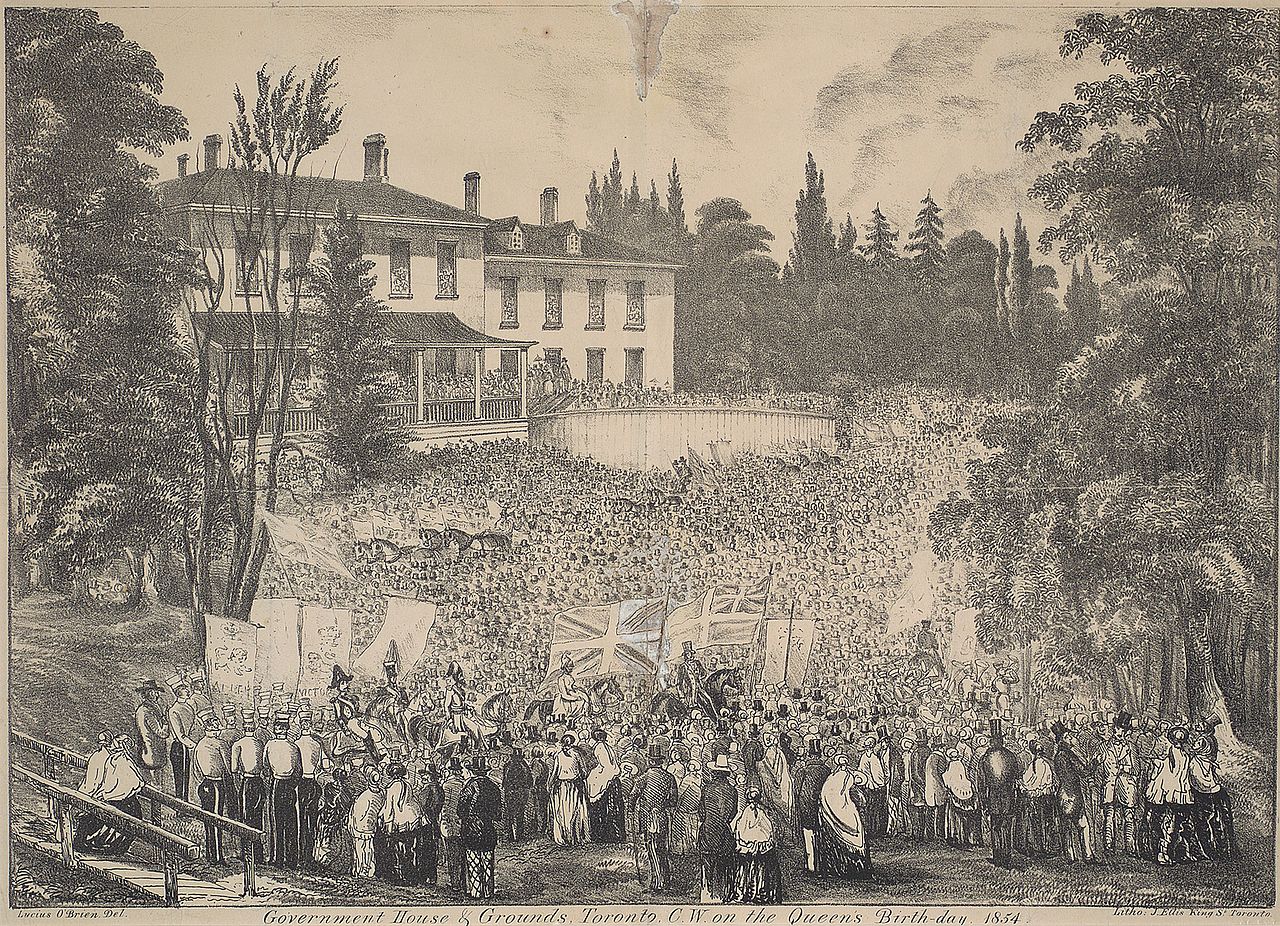
Victoria Day 1854, Toronto, Canada West
Original Kitchener, Waterloo, Ontario, Canada

May 24, 2021

If I have my arithmetic and my wikipedia facts lined up correctly, today is the 176th iteration of the celebration of Queen Victoria’s birthday here in our neck of the woods.

Victoria Day is my favourite secular holiday, for a lot of reasons, starting with how deliciously peculiar it is that, after all those years, we’re still doing this. No one else does; not in England, nor in the rest of the nations of the troubled kingdom where Victoria’s successor reigns, nor elsewhere among the 15 “Commonwealth Realm” polities that remain.

It’s not even universally celebrated in Canada: Victoria Day is a general holiday in Alberta, Manitoba, the Northwest Territories and Yukon; and a statutory holiday in British Columbia, Ontario and Saskatchewan. 

It makes sense that the peoples and nations of pre-Victorian Canada — i.e. the Atlantic provinces and  Québec — don’t partake. I wouldn’t mind if federal authorities began treating this as another celebration of Canada’s diversity. That would pave the way to reclaiming the holiday as something special to the province I live in: la Fête nationale d’Ontario, but without the overtones of Bostonais-style separatism. 

Traditions and their associations can evolve. I wouldn’t mind if the fireworks came to an end, for instance. Given that most of the meaning has been lost, and that May 2-4 gunpowder play is now almost entirely private, all that noise that went on until the wee hours last night struck me as in-your-ear version of in-your-face tagging of public vistas with spray paint.    

Regardless of how things have changed over time, an unbroken tradition of 176 years is valuable in and of itself. It would be a shame, and probably very bad luck, to break it completely. It’s always possible, of course, to start a new tradition, but we’d have to wait until 2297 to match this legacy.  

The usual arguments that Canadians should break ties with the monarchy and finally do away with these quaint, subservient practices have become an annual Victoria Day ritual of sorts. With the widely prevalent idea of colonialism being the root of all evil, this line of thinking has gained a fresh relevance. 

I don’t buy it. But I don’t believe in debate. There are myriad sides to every important question. The best way forward is to move beyond routine positions, pro versus con, towards a respect for the complexities  involved.  

In this case, coming up with a counter-argument to these latter-day republicans would not only be a waste of time, it could prove to be a reckless return to battles millions have fought and died for over the last 200+ years. 

Canada, especially Ontario, Canada, is the product of such a battle. We’re what remains of the realm of Victoria’s grandfather after the thirteen disgruntled colonies rose up to overthrow their government and establish settler home rule.

Through a convoluted personal journey, I’ve become what I like to describe as a conservatory progressive. The “tory” in conservatory is deliberate: It declares that, by temperament and conviction, I’ve become a neo-loyalist — or, better, a latter day loyalist.  

Ironically, I got this way by trying to imagine what the complete opposite would be of what passes for conservatism nowadays. I’ve been deeply concerned about how things have been unfolding here since the “Common Sense Revolution” began raging out of Queen’s Park 26 years ago.1 

When it began flaring up again with the rise of our current Premier, I was appalled. But I’ve restored my equilibrium. My sense is that Mr. Ford is cut from different cloth than Premier Harris, but his party and his leadership team remain totally immersed in the mindset and spirit of ‘95. 

Victoria Day to me is a symbol of 262 years of peaceful transition. We’ve had a few flare ups of the Yankee / Rebel spirit every now and then. This is understandable, given that we live next door to the separatist settler republic, and given that the U.S. storyline has been dominant for going on 250 years now. 

When you tell the story this way, we come out losers, cowards, sheep. Fortunately, the spirit of rebellion has never prevailed. Loyal we’ve remained, more or less. 

Symbols are what we choose to make of them. To me, the monarchy is a symbol of continuity, of evolutionary change. We’ve gotten to where we are today by adapting and building on what exists, step by step.  I think the idea of a head of state who, even though she is the commander-in-chief of the spiritual, military and civil estates of the four countries of the UK plus 15 more overseas, has absolutely no power over any of us, is simply brilliant. 

The idea of leaving succession to genetic chance, rather than personal ambition, partisan squabbling and majority rule, also has enduring merit. .    

As a latter day loyalist, I can sing “God Save the Queen” with heart and conviction. 

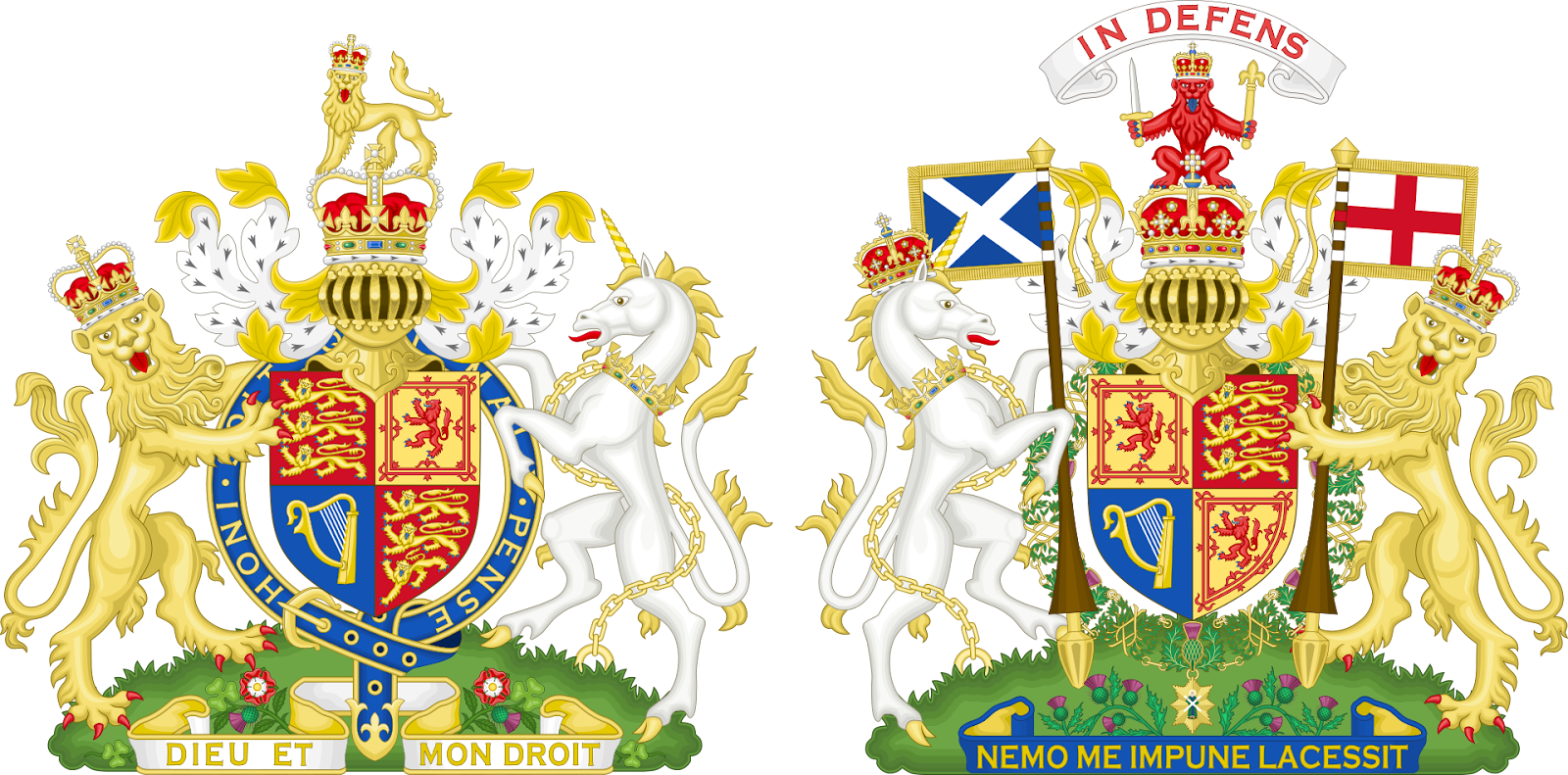
The Royal coats of arms of the United Kingdom of Great Britain and Northern Ireland as used by Queen Elizabeth II …  in Scotland (right) and elsewhere (left). – wikipedia

I should clarify, though, that a true progressive only looks forward. There is no golden age to return to, nor are there any past glories worth bragging about. It’s the future that counts.   

In this time of plague, of conflict and schism, of looming economic collapse, when efforts to redress historical wrongs appear destined to failure, and when the “Man and His World” attitudes of the 20th-century linger on to the point where such arrogance has become an existential threat to the planet itself, you have to work hard to keep a modicum of hope alive. That’s why I like to keep an eye out for omens that might be imagined as promising. 

Yesterday was Pentecost Sunday. Just as Victoria Day is my favourite secular holiday, Pentecost is my favourite spiritual holy day. I love the numbers: Seven times seven plus one equals fifty (Pentecost the the 7th Sunday, and therefore 50 days, after Easter Sunday). I love the idea of the light of the spirit visible over the heads of an assembly of believers. I love the idea of speaking in tongues that are marvelously varied yet universally intelligible. 

In the Christian story, Pentecost Sunday is as meaningful as Christmas, Easter or Thanksgiving. The fact that the modern nation state and the world of commerce have never even tried to make anything of this holy day seems almost miraculous. So Pentecost Sunday falling on Victoria Day weekend can be taken as a fortunate coincidence. 

By the same token, should the powers that be decide to abolish Victoria Day as we’ve known it once and for all, I’d make believe that this, too, is a good omen. It would be an indication that we no longer need to make this “us and them” distinction. 

It is possible that our destiny has been obscured all this time by the twin imperial storylines that have been dominant for so long. But any day now, the fog may lift. (I should mention that I like to imagine Victoria’s maritime empire and the continental superpower we’re attached to as two sides of the same coin, like Rome and its one-time colony, Constantinople, in days of old).

It may soon become apparent that Sir Wilfrid Laurier was right, but off by a century, when he prophesied that “the 20th century belongs to Canada” — or, in his exact words, “The 19th century was the century of the United States. I think we can claim that it is Canada that shall fill the 20th century.”

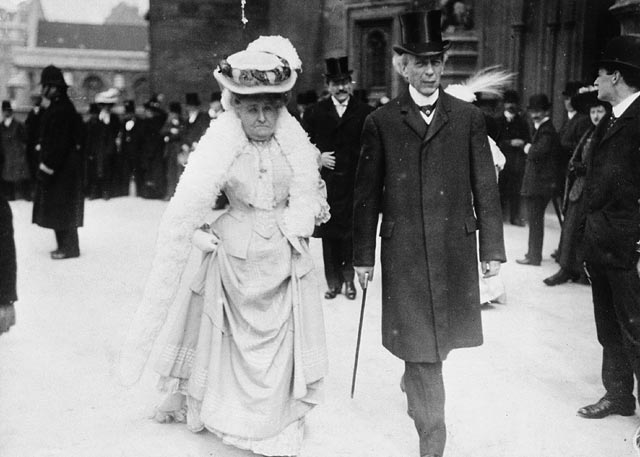
Sir Wilfrid Laurier with Zoé, Lady Laurier, in 1907 – wikipedia

The promise of the Canadas, including the  Ontario nation, may not be to right the wrongs of 1776, 1789 and all the horrors that have followed. The purpose is not to set things in order, whether from the reactionary or the revolutionary perspective, nor is it to reconcile such opposites. 

Victoria Day 2021 is a good time to imagine our manifest destiny is to show the world how to rise above conflicts that have plagued the human race since the last quarter of the 18th century, and move forward with a storyline better suited to the circumstances, challenges and possibilities of the 21st century. 

On Further Reflection: Victoria Day 2020

A statue in front of a building

Description automatically generated

photo courtesy of Cambridge photographer Vanessa Pejovic.

Tuesday May 24, 2022
Originally posted on May 20, 2020, this was my second “I am Groot” column for CultKW, a project of THEMUSEUM. I still love Victoria Day /  Fête de la Reine as celebrated in Canada, especially here in Upper Canada, for all its “quaint peculiarities.” I also have a deep and abiding fondness for Cavaliere Raffaele Zaccaquini’s landmark sculpture of Victoria and the Lion, which has become controversial of late, and subject to the same kind of desecration that led to the removal of the statue of John A MacDonald in Baden.

———-

May 20, 2020
I am writing to you from what has been my perch, my coop for more than nine weeks now: from my apartment on the third floor of an industrial heritage building in the original part of downtown Kitchener.  

That’s the part of the city that goes back to when Kitchener was still Berlin, Canada; when Queen Victoria was on her throne, and when the sun never set on her domains. 

I hope your Victoria Day weekend was a joyous one.  

Victoria’s actual birthday – her 201st – is this Sunday, so this celebration opportunity is still open. 

Monday was damp and gloomy, so I have a mind to go up the street to her statue in her park and pay my respects later in the week, in a solitary, silent and properly masked for the pandemic kind of way.  

I love Victoria Day for all its quaint peculiarities. In her time, she was a global presence (check out this Wikipedia list of statues of her imperial majesty in locations worldwide). Today, Canada is the only place where Victoria and her long, long reign are still celebrated with a statutory holiday.  

Even though it has become an almost meaningless vestige of a time gone by, Victoria Day in Canada is part of what makes us distinct.  

It is worth noting, especially since it is THEMUSEUM that is hosting these musings, that this holiday Monday that just went by was also International Museum Day.  

The theme this year was “Museum for Equality: Diversity and Inclusion”.   

That Victorian Empire of old is not something we associate with equality; that’s a specialty of revolutionary France. In terms of diversity and broad inclusion, however, there has never been a political configuration that comes close to matching the cultural breadth and variety of that vast global empire we were once part of.  

The museum connection brings to mind the Record column I wrote for Victoria Day last year, which included a mention of a small exhibit dedicated to the 200th anniversary of the birth of Queen Victoria at the Fashion History Museum in Hespeler, Cambridge. 

The “Victoria 200” exhibit included one of Victoria’s personal garments — a linen chemise — on loan from the Jordan Historical Museum of the Twenty in the Town of Lincoln, out in Niagara. 

This year, of course, the Fashion History Museum and every other museum, gallery, theatre, concert hall, community art centre and library are shut tight. 

Writing as an arts advocate, I have to say something about how grave the current situation has become for organizations like the Fashion History Museum, and for people working in culture-related endeavours of all kinds. 

Things look worse with every passing day. We can no longer just hope for the best and wait for things to return to some semblance of normal. 

This is where another aspect of what Victoria Day signifies comes into the picture: May 2-4 in these parts is the culmination of a long arc of spring observances, from Groundhog Day to the vernal equinox through Earth Day, Arbour Week, Easter, May Day, Mothers Day, to now, when we can finally plant without fear of frost and begin the turn towards summer. 

More than any other time of the year, this is the season to honour and to treasure our earthly home. 

When we consider the future of museums, galleries, archives, libraries, and conservatories, and think about how music, theatre, dance, literary, visual arts, and media, new and old, will evolve, what we’re really thinking about is the future of work.  

And any way you look at it, in 2020 the future of work means finding ways to do things for one another in more sustainable ways — all 8 billion of us alive today around this globe where the sun is always rising and always setting.  

We’ve reached the point where the ecological balance sheet is of far greater consequence than anything that can be measured in terms of dollars and cents.  

My Victoria Day 2020 wish is that we take advantage of this break from the normal and use the time to work on updating our conception of what prosperity means.  

My sense is, if culture-related work, culture-related exchange, the immeasurable value of arts-related production, and the ever-increasing riches of our shared cultural inheritance are not at the very centre of an evolved conception of true prosperity, the future starts to look hopeless and impoverished.