
This is a revised version of a contribution to THEMUSEUM’s now defunct CultKW project originally submitted May 21, 2021, presented here for the record.

The streets of Kitchener built up to 1953, when the characteristic squiggly suburban road pattern started to become dominant. Image is a screenshot showing layers covered by the interactive Kitchener Historical Street Project, created by the University of Waterloo Geospatial Centre.
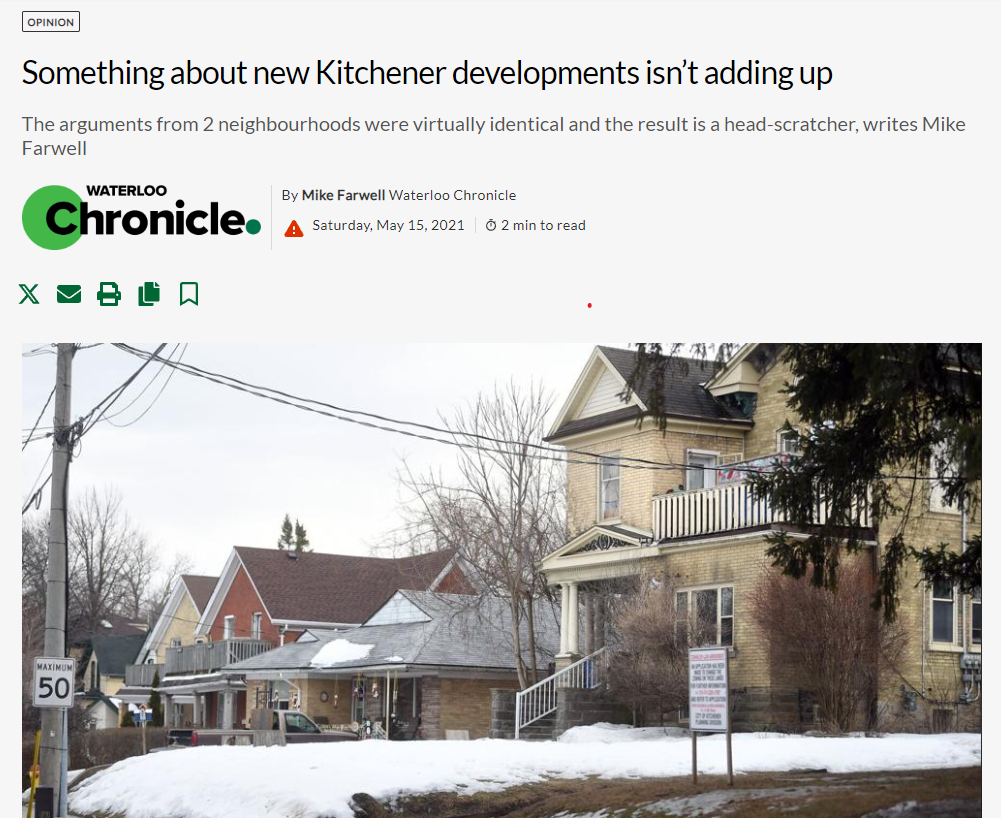
It was a Waterloo Chronicle article that reached me via therecord.com that set off my musings for this week: an opinion piece by local Barnbuilder and media personality Mike Farwell that raises questions about some recent planning decisions.
What caught my attention, first of all, was finding this essay about two controversial Kitchener highrise projects in Waterloo’s weekly. Is it the KW Chronicle now? If so, people in Waterloo should complain. What’s happened to the Kitchener Post? K-townsfolk should be concerned.
This touches on my opinion, which I’ve expressed repeatedly in these missives, that KW-centricity doesn’t serve any of the region’s eight polities very well, and that it is the people of Kitchener who have been short-changed the most.
I also have an opinion on the issue that Mike Farwell raises. He’s right, the story as he tells it doesn’t add up: If, as he contends, the “arguments from both neighbourhoods were virtually identical”, the decision to allow the highrise at Frederick and Avon to go ahead while scaling back the development at Queen and Mill is indeed “a head-scratcher”.
Farwell tells the story the same way The Record editorial on the Blair situation does: The three situations are all treated as NIMBY stories, neighbours rising up against a proposed change to say “Not In My Backyard”. But in the case of the village of Blair and the development at Queen and Mill, it is more than just the neighbours who have come forward to express concern.
Blair, as I suggested two weeks ago, is arguably the most significant heritage precinct in all of Waterloo Country. Mill Street is one of Kitchener’s original roads, adapted, they say, from an Indigenous trail pre-dating colonial settlement. In both instances, voices from all over the region concerned about heritage conservation and appreciation have been speaking up.
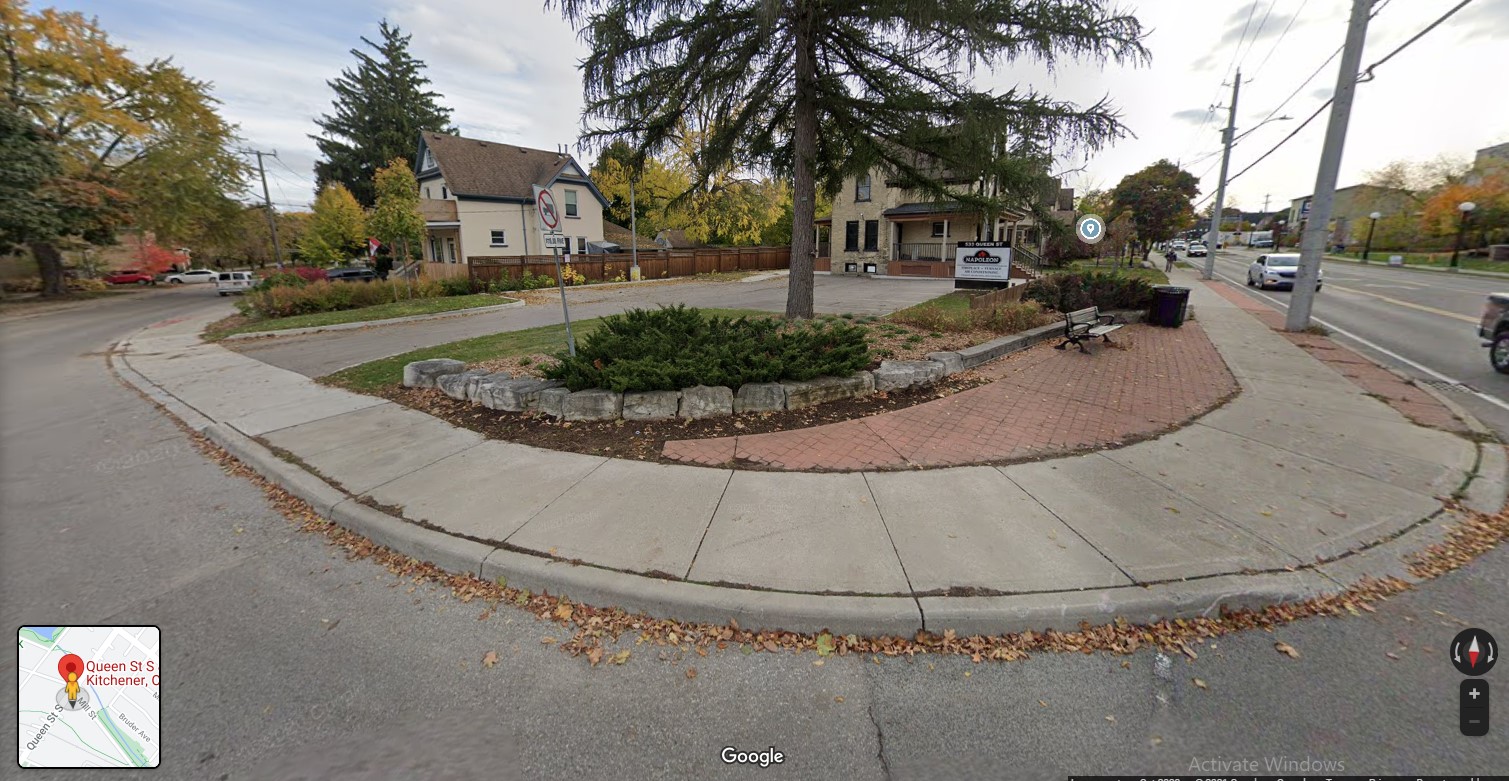
Mill and Queen looking south — Google street view screenshot
I’m certainly concerned about heritage conservation, but haven’t said anything in public about the Mill Street situation. This is partly because the respectful side seemed well-represented. I’m also familiar with the developer. I can see the Polycorp offices from the south windows of my coop at the co-op, situated in a magnificent “Original Kitchener” heritage structure. I hoped, and trusted, that they cared enough to at least listen to our concerns.
But the main reason I kept mum is because I’m a firmly convinced and deeply committed “conservatory progressive”.
As a progressive, I know time doesn’t stand still. There is no going back to some imagined golden past. It is today that matters, in relation to tomorrow: The future will be the world we choose to make it, or what we allow to happen.
If this forward-looking attitude sounds reasonable, my “conservatory” bent may not: I’m not just calling for the protection of a few exceptional architectural gems from the ravages of heedless profit-seeking, neglect and time. I’m anchoring my hopes for the future on an imminent emergence of a profound respect for all heritage, cultural as well as natural.
The corner of Mill and Queen lies within what I like to call “Original Berlin/Kitchener”. Every village, town and city founded 100 or more years ago has a foundational core: Basically, this means all precincts that predate the rise of standard suburban growth patterns centred around the automobile.
Just as we now have a “Countryside Line” to protect the waters, the farmlands and the forests of Waterloo, I’m advocating for an “Original Town Line”, with distinct planning practices for contiguous areas built before 1950 or so, as well as special consideration of everything that has been built since then.
It’s not that one is better than the other; it’s that they’re different. The suburbs are designed for getting around in cars; the older building patterns are suited for people walking, cycling and for slower, mostly horse-drawn traffic.
And whether it’s within the Original Town Line or beyond, my preference is for the kind of “socially conscious and sustainable” building design that is practiced by Anne Lacaton and Jean-Philippe Vassal, whose work has been honoured with the 2021 Pritzker Architecture Prize.
When I heard about “their reverence for pre-existing structures, conceiving projects by first taking inventory of what already exists”, and their resolve to avoid any and all demolition, the thought that immediately came to mind was: “This is the future.”
Such views, however, are only just beginning to emerge. My sense is that entering the fray over the future of Blair or the junction of Queen and Mill with a battle cry like “never demolish” would likely do more harm than good to the cause.
So instead of taking a side, I’m returning to the point I tried to make two weeks ago: This isn’t a battle. The objective is the best possible outcome for the village or neighbourhood, for Cambridge and for Kitchener; for the people of the region today, and for people who will live, work, play and learn here throughout the rest of the century and beyond. These are not matters for debate, but for patient, comprehensive and considerate deliberation.
Civic deliberation, which in this context means democratic deliberation within a municipality and/or a watershed, is best served by avoiding any kind of two-way standoff, and starting by broadening the view of what needs to be taken into account, thereby complicating the picture.
To be effective, inclusive and meaningful, civic deliberation needs to move “beyond opinion”.
Mike Farwell’s essay got me thinking, and I appreciate that. Rather than challenge his view that Mill and Queen is a better location than Frederick and Avon for density, the intention here is to complicate the picture, not only by drawing attention to the heritage factor, but also by raising the the fundamental question that Rick Haldenby of Waterloo Architecture is going to address in his upcoming for Kitchener Public Library: “What Kind of City Are We Building?”
 Martin de Groot